











wipro

sofrecom

mobilis

alstom

ericsson

celcite

Success Stories
More articles from resource
AI and the City of Tomorrow
Cognitive cities are redefining urban development by turning data into real-time understanding and action. In this article, we will cover how these cities go beyond traditional smart city models, already enhancing mobility, sustainability, and public services, while addressing key challenges around data privacy and governance. He also highlights why cities that move early will gain a lasting competitive advantage.
Cognitive cities are often mistaken for more advanced versions of smart cities, built simply on additional sensors and data tools. In reality, Cognitive cities are capable to interpret information, anticipate demand, and orchestrate responses across transport, energy, healthcare, and public services.
What truly defines a cognitive city is not technology itself, but its capacity to raise quality of life, strengthen resilience, and deliver services that are more responsive, fair, and sustainable—with people always at the core.
What truly defines a cognitive city is not technology itself, but its capacity to raise quality of life, and deliver services that are more responsive—with people always at the core.
Today Advanced AI systems can foresee traffic bottlenecks well before they occur, allowing cities to adapt traffic signals, reroute public transport, and spread vehicle flows more evenly—cutting emissions and saving time. Singapore’s predictive traffic management is a notable benchmark.
With smarter waste and resource operations cities can significantly reduce costs and environmental impact while improving cleanliness. Barcelona stands out as a pioneer in intelligent waste management.
Cognitive cities are redesigning administrative processes through digital identity, automation, and secure ledgers, shrinking approval times from weeks to hours. Dubai’s use of blockchain to modernize public services illustrates this transformation.
Cities With Human-Centered Design
However, the main obstacle facing cognitive cities is not the technology itself, but how it is governed. Success depends on trusted data-sharing, strong ethical safeguards that protect privacy, interoperable digital systems, robust cybersecurity, and new capabilities within public institutions. Cognitive cities deliver real value only when advanced technology is matched with effective governance and human-centered design—without this balance, even the most powerful AI can fall short.
Positioned to Lead
Moving from smart to cognitive represents a fundamental shift in how cities operate. Those that move early can lower costs and emissions, raise the quality of public services, boost resilience to disruptions, and become more attractive to talent and investors—while delivering tangible improvements to everyday life for residents. Cognitive capabilities will emerge as a decisive advantage not in the distant future, but within the next three to five years. Cities that are already preparing—or acting now—will be best positioned to lead. The moment to move is now.
Beyond 5G Capabilities
The transition to 6G will mark a fundamental shift in how digital systems interact with the physical world. The next wave of connectivity will not simply enhance speed or capacity—it will redefine what is technically and economically possible across industries.
Future networks are expected to enable autonomous systems powered by continuous AI decision-making, and advanced virtual representations of real-world assets through intelligent digital twins. These capabilities will allow organizations to operate with unprecedented responsiveness, precision, and resilience, while creating entirely new categories of services and revenue models.
“Broader commercial adoption is expected progressively, with mainstream availability emerging around 2030”
From industrial automation to sustainable infrastructure and global innovation ecosystems, this new connectivity layer is poised to become a critical foundation for long-term economic and technological growth.
Initial pilot deployments and experimental trials are anticipated by 2028, focusing on research environments and early proof-of-concept implementations.
Today we will examine the transformative opportunities introduced by next-generation networks, analyzes the technological and economic forces driving their development, and outlines the key obstacles that must be addressed before their full promise can be realized.
Enabling New Forms of Value Creation
Next-generation connectivity will act as a catalyst for entirely new economic opportunities. As network intelligence and responsiveness increase, organizations will be able to design offerings that were previously impractical or impossible.
These capabilities will support deeply interactive digital environments, services delivered in real time, and solutions built on continuous data intelligence. As a result, companies will not only enhance existing services but also create new categories of products and business models, opening access to unexplored markets and revenue streams.
Transforming Operational Efficiency
6G technologies will provide the foundation for highly optimized enterprise operations. With near-instant data exchange, embedded intelligence, and virtual replicas of physical systems, organizations will be able to monitor, predict, and adjust processes in real time.
This level of connectivity enables automated decision-making, continuous optimization, and more accurate simulations of operational environments. The result is leaner workflows, reduced operational overhead, and improved cost efficiency across the value chain.
Advancing Sustainable and Responsible Operations
6G will play a critical role in enabling more responsible use of energy, materials, and infrastructure. By combining continuous data flows with intelligent control mechanisms, organizations can gain visibility into how resources are consumed and where inefficiencies arise.
This enhanced awareness supports real-time optimization, predictive adjustments, and smarter automation, allowing businesses to lower their environmental footprint while accelerating innovation in sustainable products and services. The outcome is a stronger alignment between operational performance, environmental responsibility, and long-term value creation.
Agentic AI as a Driver of Next-Generation Strategy
Agentic AI systems are rapidly moving beyond experimentation and into the core of enterprise operations. Their ability to reason, plan, and act independently is redefining how organizations approach productivity, automation, and innovation at scale. Yet this shift raises a fundamental question: how can enterprises deploy such capabilities responsibly, without losing control, visibility, or trust?
Leading practitioners are already demonstrating that agent-based AI can deliver tangible business outcomes when applied to well-defined, real-world scenarios. These early implementations show measurable gains in efficiency, decision quality, and operational resilience—provided that agents are introduced within a clear governance structure.
“By embedding transparency, accountability, into every stage of agent deployment, organizations can move from isolated pilots to production-grade systems.”
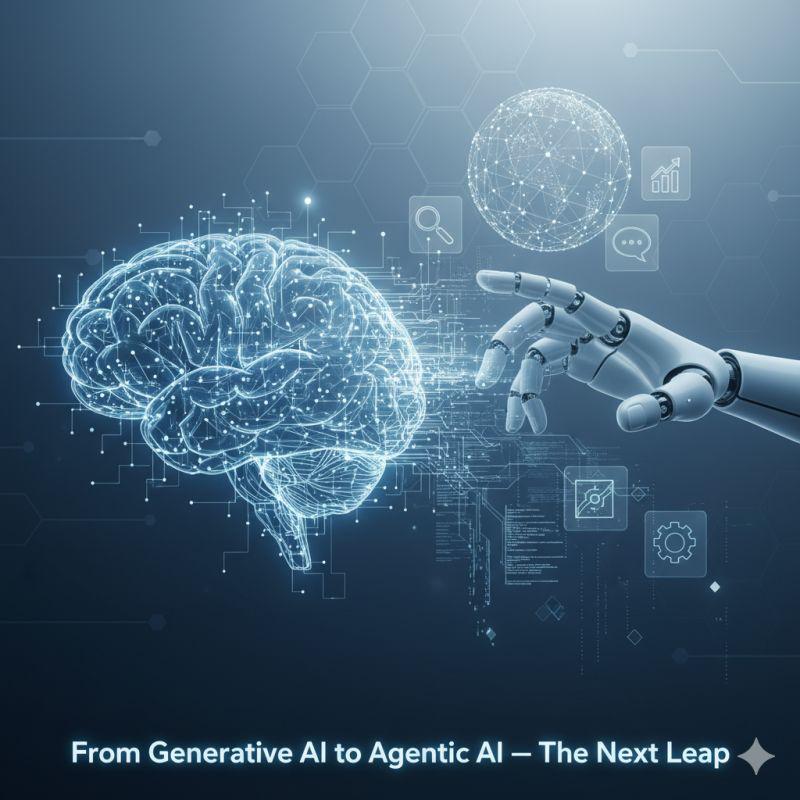
Today we explore the emerging role of agentic AI in the enterprise, examining both its transformative potential and its inherent challenges. It outlines the practical steps required to transition toward a new generation of intelligent organizations—where autonomous systems augment human decision-making.
From Automation to Agentic Intelligence
Agentic AI represents a decisive shift in the evolution of artificial intelligence, moving beyond both traditional automation. To understand its impact, it is essential to distinguish what truly sets it apart from previous approaches.
Conventional automation relies on predefined rules and static workflows. While effective for repetitive and predictable tasks, it lacks flexibility and cannot adapt when conditions change. Generative AI introduced a major leap forward by enabling machines to understand context, interpret language, and generate sophisticated reasoning outputs. However, despite its analytical power, it remains largely reactive: it responds when prompted but does not independently carry work to completion. This limitation creates a persistent disconnect between insight and execution. Humans are still required to translate AI-generated analysis into concrete actions, coordinate systems, and oversee process continuity.
Agentic AI closes this gap. It fuses cognitive capabilities with autonomous execution. Intelligent agents are designed with objectives, constraints, memory, planning mechanisms, and access to tools, allowing them to operate across multiple steps without continuous human intervention. They can interpret goals, decompose complex problems, take action, assess outcomes, and iteratively refine their behavior until the task is fully achieved.
“In essence, while generative AI enhances decision-making, agentic AI transforms decision-making into decisive action—artificial intelligence becomes an operational partner rather than a support tool.”
Transforming Operational Efficiency
6G technologies will provide the foundation for highly optimized enterprise operations. With near-instant data exchange, embedded intelligence, and virtual replicas of physical systems, organizations will be able to monitor, predict, and adjust processes in real time.
This level of connectivity enables automated decision-making, continuous optimization, and more accurate simulations of operational environments. The result is leaner workflows, reduced operational overhead, and improved cost efficiency across the value chain.
Advancing Sustainable and Responsible Operations
6G will play a critical role in enabling more responsible use of energy, materials, and infrastructure. By combining continuous data flows with intelligent control mechanisms, organizations can gain visibility into how resources are consumed and where inefficiencies arise.
This enhanced awareness supports real-time optimization, predictive adjustments, and smarter automation, allowing businesses to lower their environmental footprint while accelerating innovation in sustainable products and services. The outcome is a stronger alignment between operational performance, environmental responsibility, and long-term value creation.